 Cupie
Free tool
The 36 Questions to Fall in Love (Full List, Word for Word)
Quick answer
The 36 questions to fall in love come from a 1997 study by psychologist Arthur Aron and colleagues: two people take turns answering 36 increasingly personal questions in three sets of 12, about 15 minutes per set. They reliably build a feeling of closeness, not guaranteed love. The famous 4 minutes of eye contact comes from Mandy Len Catron's 2015 New York Times essay, not the original paper.
Tap the button for a random question.
Better on a call: ask it face to face on Cupie.
The 36 questions to fall in love come from a 1997 study by psychologist Arthur Aron and four colleagues. Two people take turns asking and answering 36 questions that start light and get more personal, split into three sets of 12. It takes about 45 minutes. Below you get the full list, word for word from the original paper, plus how to do it right, what the science really found, and how to do it with your partner over a video call.
What are the 36 questions to fall in love?
They are a list of questions and small tasks from a paper called "The Experimental Generation of Interpersonal Closeness: A Procedure and Some Preliminary Findings." It was written by Arthur Aron, Edward Melinat, Elaine N. Aron, Robert Darrin Vallone and Renee J. Bator, and published in Personality and Social Psychology Bulletin in April 1997 (volume 23, issue 4, pages 363 to 377).
The researchers wanted a simple, repeatable way to make two strangers feel close in a lab, so they could study closeness. Their answer was a "sharing game." Each question asks you to open up a little more than the last one, and your partner does the same. That back-and-forth sharing is what builds the feeling of closeness.
The list became famous in January 2015, when writer Mandy Len Catron published "To Fall in Love With Anyone, Do This" in the New York Times Modern Love column. She tried the questions with someone she knew a little, and they fell in love. More on that below.
How do you do the 36 questions? (the rules from the study)
The original instructions are short. Here they are in plain words:
- Take turns reading. One of you reads the first question out loud. Then you both answer it, starting with the person who read it.
- Switch who goes first. For the next question, the other person reads and answers first. Keep alternating the whole way.
- Go in order and don't skip. The questions are built to get deeper step by step. Skipping the hard ones breaks the effect.
- Give each set about 15 minutes. In the study, pairs got 15 minutes for Set I, then were told to move on to Set II, then Set III. You don't need to finish a set before the time is up. It is better to answer fewer questions properly than to rush.
- Answer for real. The instructions say to take plenty of time with each one, "thoroughly and thoughtfully."
A few questions are tasks, not questions. For example, number 11 asks you to tell your life story in 4 minutes, and number 22 asks you to name five good things about your partner, taking turns. If it is a task, you do it first, then your partner does it.
Tip for couples: the questions say "your partner," but in the study that meant the person sitting across from you, often a stranger. If you are already dating, the questions still work. You will just find out new things about someone you thought you knew.
Set I: the first 12 questions
Set I is the warm-up. These are easy, a bit playful, and help you relax. Don't race through them: number 11 alone takes 8 minutes if you both do it.
- Given the choice of anyone in the world, whom would you want as a dinner guest?
- Would you like to be famous? In what way?
- Before making a telephone call, do you ever rehearse what you are going to say? Why?
- What would constitute a "perfect" day for you?
- When did you last sing to yourself? To someone else?
- If you were able to live to the age of 90 and retain either the mind or body of a 30-year-old for the last 60 years of your life, which would you want?
- Do you have a secret hunch about how you will die?
- Name three things you and your partner appear to have in common.
- For what in your life do you feel most grateful?
- If you could change anything about the way you were raised, what would it be?
- Take 4 minutes and tell your partner your life story in as much detail as possible.
- If you could wake up tomorrow having gained any one quality or ability, what would it be?
Set II: questions 13 to 24
Set II goes deeper. You talk about dreams, memories, family and what love means to you. This is usually where the conversation starts to feel different from a normal date.
- If a crystal ball could tell you the truth about yourself, your life, the future, or anything else, what would you want to know?
- Is there something that you've dreamed of doing for a long time? Why haven't you done it?
- What is the greatest accomplishment of your life?
- What do you value most in a friendship?
- What is your most treasured memory?
- What is your most terrible memory?
- If you knew that in one year you would die suddenly, would you change anything about the way you are now living? Why?
- What does friendship mean to you?
- What roles do love and affection play in your life?
- Alternate sharing something you consider a positive characteristic of your partner. Share a total of 5 items.
- How close and warm is your family? Do you feel your childhood was happier than most other people's?
- How do you feel about your relationship with your mother?
Inside the Cupie app
Get Closer: Cupie's take on the 36 questions
Word for word from the Get Closer deck in Cupie. The deck has 130 cards.
- PerceptionWhat's your favorite thing to see me wear? (Nothing doesn't count.)
- PerceptionWhat do you think my view on marriage is? Explain.
- PerceptionIf we weren't in a relationship, what pick up line would you use with me?
- ConnectionHow do our strengths and weaknesses complement each other?
- ConnectionWhat has this relationship taught you about yourself?
- ConnectionWhen was the last time someone betrayed your trust? How did that affect your ability to trust today?
- ReflectionWhat is a lesson about love that you'll take away from this game?
- ReflectionIn your opinion, how am I holding myself back the most?
- ReflectionWhat part of my heart do you wish you could heal?
Set III: questions 25 to 36
Set III is the most intense. Several of these are about each other, right now, in the room. It can feel awkward. That is the point. Stay with it.
- Make 3 true "we" statements each. For instance "We are both in this room feeling..."
- Complete this sentence: "I wish I had someone with whom I could share..."
- If you were going to become a close friend with your partner, please share what would be important for him or her to know.
- Tell your partner what you like about them; be very honest this time saying things that you might not say to someone you've just met.
- Share with your partner an embarrassing moment in your life.
- When did you last cry in front of another person? By yourself?
- Tell your partner something that you like about them already.
- What, if anything, is too serious to be joked about?
- If you were to die this evening with no opportunity to communicate with anyone, what would you most regret not having told someone? Why haven't you told them yet?
- Your house, containing everything you own, catches fire. After saving your loved ones and pets, you have time to safely make a final dash to save any one item. What would it be? Why?
- Of all the people in your family, whose death would you find most disturbing? Why?
- Share a personal problem and ask your partner's advice on how he or she might handle it. Also, ask your partner to reflect back to you how you seem to be feeling about the problem you have chosen.
On a video call, number 25 works best if you say "We are both on this call feeling..." instead of "in this room."
What about the 4 minutes of eye contact?
Most people know the 36 questions as "36 questions, then stare into each other's eyes for 4 minutes." But the eye contact is not part of the 1997 paper. The published procedure ends after Set III, when pairs fill out a questionnaire.
The 4-minute stare became famous through Mandy Len Catron's 2015 essay. She described the lab version as ending with four minutes of silent eye contact, and she and her date did that step on a bridge late at night after doing the questions over drinks at a bar.
So the eye contact is optional, but we think you should do it. Here is how:
- Set a timer for 4 minutes so nobody has to watch the clock.
- Sit facing each other, close enough to see each other's eyes clearly.
- Don't talk. Laughing in the first minute is normal. Just keep looking.
- When the timer ends, tell each other one thing you felt. Keep it short.
On a video call, look at the camera dot, not at your partner's face on the screen. If you both look at the screen, it looks like you are both looking down. Some people prefer to look at the screen anyway, because it feels more natural. Try both and pick what feels closer.
Do the 36 questions actually make you fall in love?
Not by magic, no. Here is what the research really found:
- They create closeness, fast. In the 1997 study, students who did the 36 questions felt much closer to their partner than students who spent the same 45 minutes on small-talk questions (like "How did you celebrate last Halloween?").
- Matching didn't matter much. Pairs got close whether or not they agreed on important topics, and whether or not they were told they would like each other.
- Love takes more. The authors were clear that the questions create a feeling of closeness, not commitment, loyalty or attraction. Those take time.
- One couple did marry. The paper mentions that in an earlier, longer version of the procedure, one pair later married. That is one story, not proof.
- It helps couples, too. A 2014 study from Wayne State University had about 150 couples do a version of the questions with another couple. Couples who shared personal things reported more passionate love for their own partner afterward than couples who made small talk.
Why does it work? Psychologists call it reciprocal self-disclosure. You share something personal, your partner responds kindly and shares something back, and both of you feel safe to share a bit more. The 36 questions just speed up the way real relationships grow.
And Catron? In a 2025 New York Times piece, she shared that she and the man from her essay are now married. They had the questions in a bowl at the wedding bar.
How to do the 36 questions over a video call
If you are long distance, or just apart tonight, you can still do the full thing. A video call works much better than text, because so much of the effect comes from seeing your partner react while you share. Here is a setup that works:
- Book 60 minutes. 45 for the questions, a few for the 4-minute eye contact, and some extra to talk after.
- Use headphones and a quiet room. Hard questions are harder when your roommate can hear you.
- Prop your phone at eye level. You want to see each other's faces, not chins.
- Share the same list. Keep this page open on a second screen, or use the random question picker at the top to pull one at a time.
- Keep a 15-minute timer for each set. When the timer goes off, move to the next set.
- Finish with the stare. Set a 4-minute timer, look at the camera, and don't talk.
Cupie is a free video-call app for couples that makes this easier. You call your partner inside the app and play games together, synced live on both phones. For deep conversations, Cupie has question decks like Get Closer and Get Deeper that you both see at the same time, so nobody has to read out loud from another screen. It is free on iPhone and Android, and it is only for the two of you: no feed, no usernames, no friend requests.
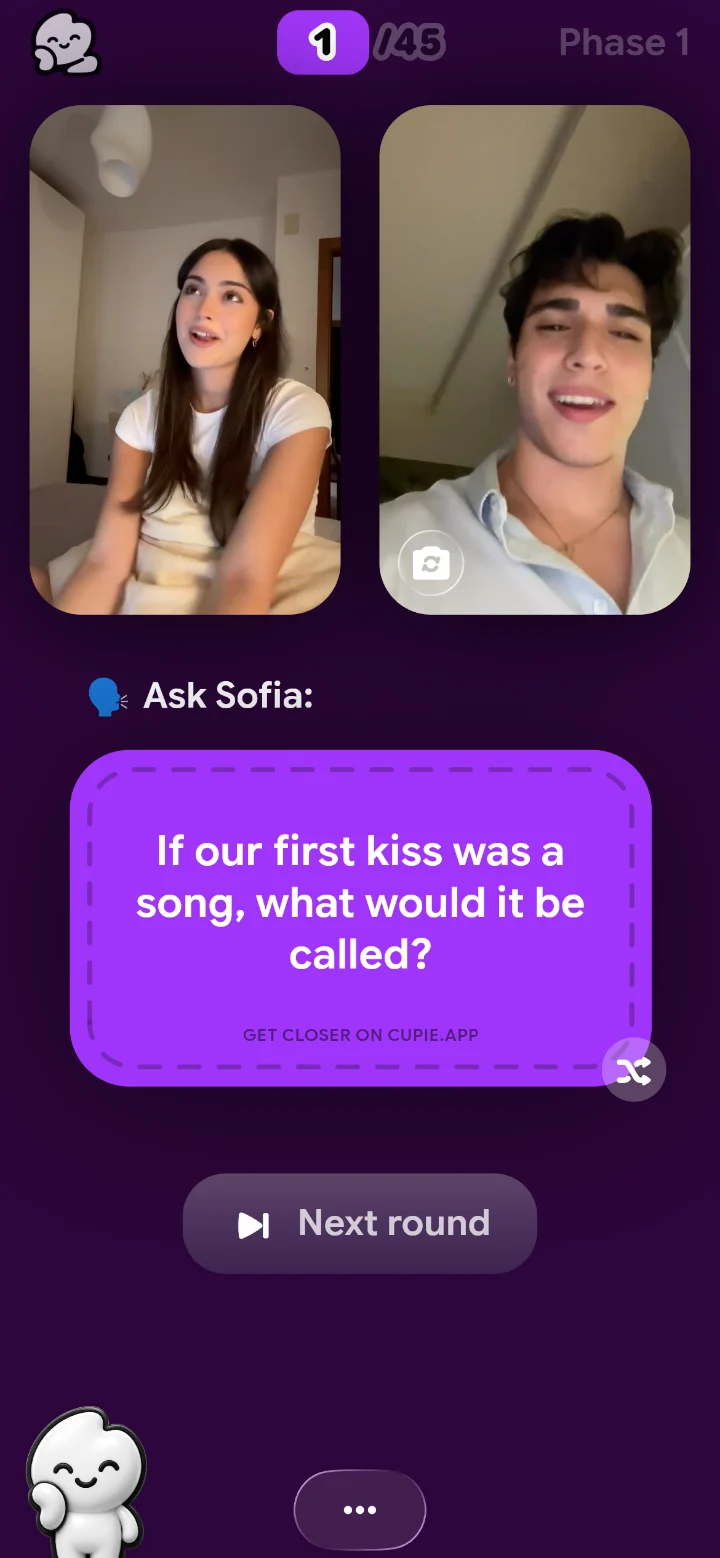
One honest note: Cupie's decks are Cupie's own questions, not the 36 from the study. If you want the exact Aron list, use this page alongside the call. If you want more after you finish, the decks are a good next step.
"me and my partner are long distance with me being in the military and we downloaded this yesterday and it was brilliant." (App Store review, UK)
Tips to get the most out of the 36 questions
- Don't do it while texting. Typing kills the rhythm. Do it in person or on a video call.
- Put phones on do not disturb. One notification can ruin a Set III answer.
- Listen more than you plan. Don't spend your partner's answer thinking about yours.
- React kindly. The research points to responsiveness as key. A nod, a "that makes sense," or a follow-up question matters.
- It's okay to pass on a question that hurts. Numbers 18, 24 and 35 can bring up grief or family pain. Say so, and share what you can.
- Repeat it in a year. Your answers change. Couples often enjoy comparing.
Bonus: follow-up questions for couples who already know each other
If you have been together a while, some answers won't surprise you. These extra questions (written by us, not from the study) push past what you already know. Use them after Set III, or on another night.
- What is something you believed about me when we first met that turned out to be wrong?
- Which moment in our relationship do you replay in your head the most?
- What is one thing I do that makes you feel safe, even if I don't know I do it?
- When did you first know you wanted to keep seeing me?
- What is a fear about us that you have never said out loud?
- What part of your life do you wish I asked about more?
- If we could relive one ordinary day together, which one would you pick?
- What is a habit of mine you secretly love?
- What do you want our life to look like five years from now, on a normal Tuesday?
- What is something you are proud of that you have never told me?
- When do you feel most far away from me, even when we are together?
- What is one promise you would like us to make to each other tonight?
What to do after the 36 questions
Once you finish, keep the momentum going with something lighter. Try our couples quiz to see how well you know each other, or switch to would you rather questions for couples for a laugh. For more deep talk, there are plenty of deep questions to ask your partner. And if you are long distance, our long distance date ideas has more ways to spend a night together on a call.
FAQ
Who made the 36 questions to fall in love?
Psychologist Arthur Aron and four colleagues (Edward Melinat, Elaine N. Aron, Robert Darrin Vallone and Renee J. Bator) published them in 1997 in Personality and Social Psychology Bulletin. They went viral in 2015 through Mandy Len Catron's New York Times Modern Love essay.
How long do the 36 questions take?
About 45 minutes. In the study, pairs spent 15 minutes on each of the three sets. Add 4 minutes if you do the eye contact at the end, and some time to talk afterward.
Is the 4 minutes of eye contact part of the original study?
No. The 1997 paper ends after Set III. The 4 minutes of silent eye contact became famous through Mandy Len Catron's 2015 essay, where she and her date did it on a bridge after answering the questions.
Do the 36 questions really work?
They work for closeness. In the study, pairs who did the 36 questions felt much closer than pairs who made small talk for the same time. The authors said they do not create commitment or attraction on their own, so think of them as a strong start, not a love potion.
Can couples who are already together do the 36 questions?
Yes. A 2014 Wayne State University study found couples who did a version of the questions with another couple reported more passionate love for their own partner. Long-term couples usually still learn something new.
Can you do the 36 questions over FaceTime or a video call?
Yes, and it works far better than text because you see each other react. Use headphones, keep your phone at eye level, time each set, and for the eye contact step look at the camera instead of the screen.
How we made this page: researched and drafted with help from AI tools, then reviewed and edited by Niclas Illg against the sources below and the official app listings on October 19, 2026. Cupie is our own app, and we say so wherever we compare it.
Sources
- Aron, Melinat, Aron, Vallone and Bator (1997), The Experimental Generation of Interpersonal Closeness, Personality and Social Psychology Bulletin 23(4)
- Mandy Len Catron, To Fall in Love With Anyone, Do This, The New York Times Modern Love (January 2015)
- She Wrote About 'The 36 Questions That Lead to Love' and Now, She's Married, The New York Times (May 2025)
- 36 Questions for Increasing Closeness, Greater Good in Action (UC Berkeley)
- Can 36 questions really change your love life? The Conversation (February 2026)
- Going on a double date may be more effective at reigniting passion in own relationship, says study (News-Medical, February 2014)