 Cupie
Data and guide
Do long distance relationship apps actually work? What our 2026 data shows
Quick answer
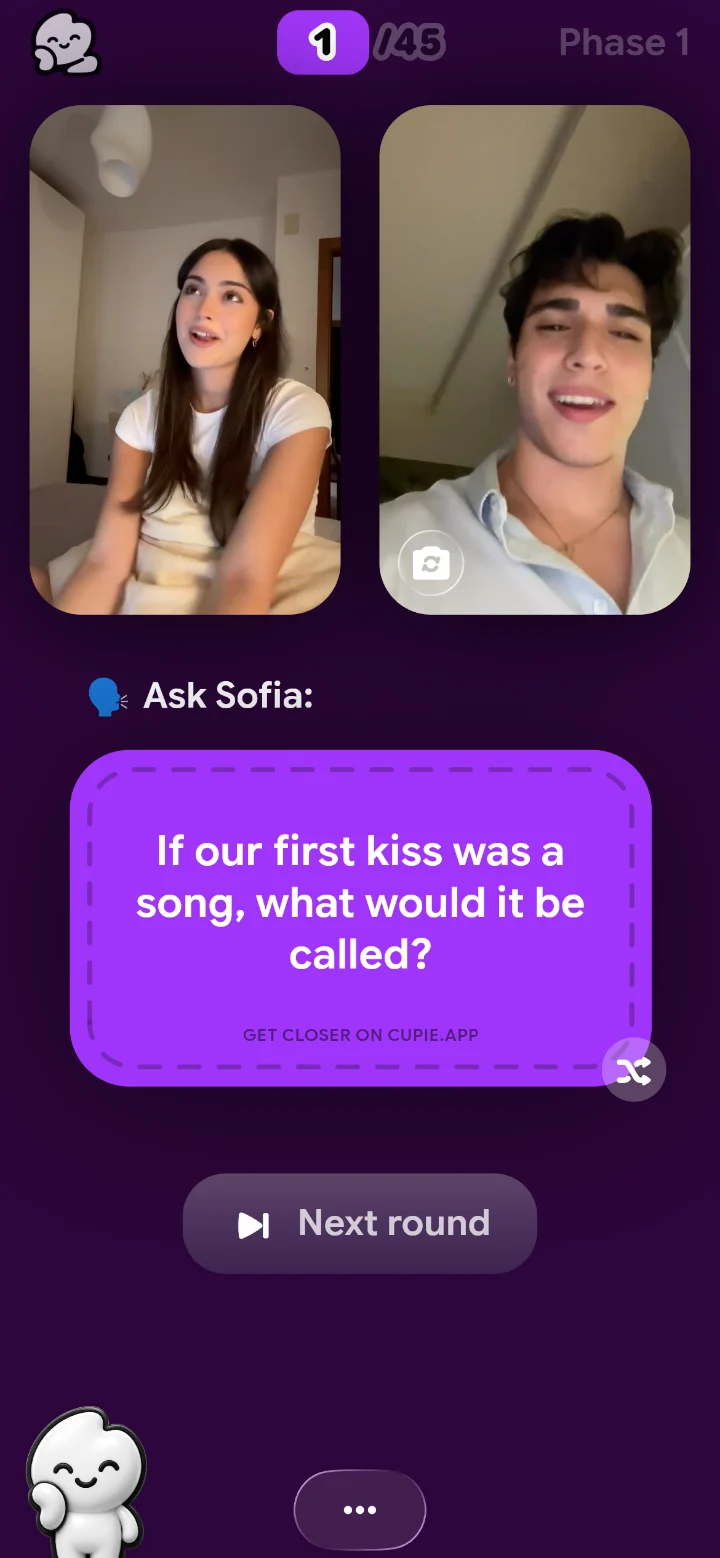
Long distance relationship apps help when they give you something to do together, not just something to check. In our 2026 data from couple calls on Cupie, 70.5% of calls included a game, and calls with a game lasted a median of 23.3 minutes versus 6.6 minutes without one (a correlation, not proof). Research finds long distance couples can match or beat nearby couples on closeness, but no app replaces a fixed call routine, a next visit on the calendar and a plan to end the distance.
Updated October 2026. Short answer: long distance relationship apps work when they give you something to do together, and they do little when they only give you something to check. In our 2026 data, couple calls on Cupie, a free video calling app for couples on iPhone and Android where you play games together live inside the call, were about 3.5 times longer when a game was played. Research on long distance couples is also more hopeful than most people expect. But the things that make long distance work are habits: a fixed call time, a next visit on the calendar and a plan to end the distance. Apps make those habits easier. They don't replace them.
What does our 2026 data show?
We looked at couple video calls on Cupie from July 22 to October 19, 2026. These are totals across many couples; we never looked at names, messages, answers or call audio. Here are the findings that matter for long distance couples.
70.5%
of couple calls include at least one game
23.3 vs 6.6
median minutes for calls with a game vs without
32.1%
of couples have partners in different time zones
10 pm
is the busiest hour for couple calls, local time
| Finding | What it means for you |
|---|---|
| 7 in 10 calls included a game | Couples don't only want to talk. Having something to do is the normal case, not a gimmick. |
| Median call with a game: 23.3 min. Without: 6.6 min | Calls with games run longer. This is a correlation: longer calls also have more time for a game. Among calls of 10 minutes or more, calls with games still ran longer (31 vs 25 minutes). |
| The game most couples played was Get Closer, a question deck | The top "game" is a conversation. Questions give a tired call a new topic. |
| 32.1% of couples call across time zones; up to 23.7% across countries | If you are long distance, you are a big part of the people using these apps. |
| Busiest hour 10 to 11 pm; 4 in 10 calls start 9 pm to midnight | Most couples call at the end of the day. Plan for tired brains: easy games and light questions work best. |
| Partners matched 64.4% of answers in couple quizzes on average | Even close couples have a third of things to learn about each other. That is a lot to talk about. |
Full numbers, game rankings and method are in the Cupie data report 2026.
What does research say: will a long distance relationship work?
Often, yes. Two well known studies are worth knowing:
- Long distance couples can feel closer. In a diary study by Crystal Jiang and Jeffrey Hancock (Journal of Communication, 2013), long distance couples talked fewer times a day but reported more intimacy than nearby couples. They shared more about themselves and tended to idealize their partner. In the authors' words, they "try harder" to show affection.
- Quality can be the same or higher. Kelmer and colleagues (Family Process, 2013) compared 870 people in long distance and nearby relationships. Long distance partners reported equal or higher quality on several measures, including love, fun together and quality of conversation. But at follow-up they were just as likely to have broken up as nearby couples.
So distance is not the main risk. The risk is what happens around it: whether you keep showing up, whether you have an end date, and whether the real person matches the one on your screen.
What kills long distance relationships?
- No end date. "Someday" is hard to hold on to. Even a rough plan ("we decide on a city by next summer") gives both of you something to work toward.
- The same call every night. "How was your day?" "Fine." Calls that turn into a report get shorter and then stop. A game or a question deck changes the script.
- Unbalanced effort. When one partner always stays up late, always books the flight or always starts the call, resentment grows. Take turns.
- Jealousy you don't talk about. Silence fills with guesses. Say it early and calmly.
- The idealization gap. Research shows long distance partners tend to idealize each other. Visits where you share boring, real life (grocery runs, a bad mood) close that gap before you move together.
How do you make a long distance relationship work?
- Set fixed call times. Two or three calls you can keep beat seven you keep missing. Book the next one before you hang up.
- Do something on the call. Play a game, answer a question deck, cook the same recipe or watch the same show.
- Always have a next visit on the calendar. A date to count down to changes how the waiting feels.
- Talk about the end of the distance. Who moves, where, roughly when.
- Share small moments in between. A photo, a voice note, a silly answer to a quiz. Little and often beats rare and big.
- Keep your own life. Friends, hobbies and goals where you live make you a better partner on the call.
If you live in different time zones, our guide on apps and calling windows for different time zones shows how to pick a call time for any gap. For more habits, read our long distance relationship tips.
How we looked at this
- Our data: completed 1:1 video calls of 60 seconds or more on Cupie, July 22 to October 19, 2026. A game counts when the partner accepted it and it started. Time of day uses the caller's own device time zone. Only totals across many couples; every group shown has at least 50 couples. Team and test accounts were removed.
- What we can't measure: we don't know if couples stay together, so we can't say an app saves relationships. We can only say what couples do on calls. Calls with games being longer is a correlation, not proof of cause.
- Research: we used published studies and summaries linked in the sources below.
- Reviews: star ratings and critical reviews come from the US App Store listings, checked in October 2026.
- Our bias: Cupie is our app. We put the limits of every app type on this page, including ours.
Which couples apps make long distance feel less lonely?
Different app types solve different problems. Here is what each one does well and where it falls short.
| App type | Examples | Helps with | Falls short when |
|---|---|---|---|
| Video calls with games | Cupie | Calls that feel like a date, not a report | You can't find a shared hour, or one of you hates video |
| Daily question apps | Paired, Agapé, Lovewick | New topics, answered on your own time | Questions start to repeat, or the paywall hides most content |
| Home screen widgets | Locket, Widgetable, Couple Joy | Feeling your partner nearby all day | You want real conversation; widgets are a nudge, not a talk |
| Private messengers | Between | Keeping couple chat and photos in one place | You already text all day in another app |
| Watch together | Teleparty | Movie nights in sync | You both need the same streaming service |
| Shared calendars | Cupla, TimeTree | Planning visits and calls across time zones | You need closeness, not logistics |
Live calls with games: Cupie
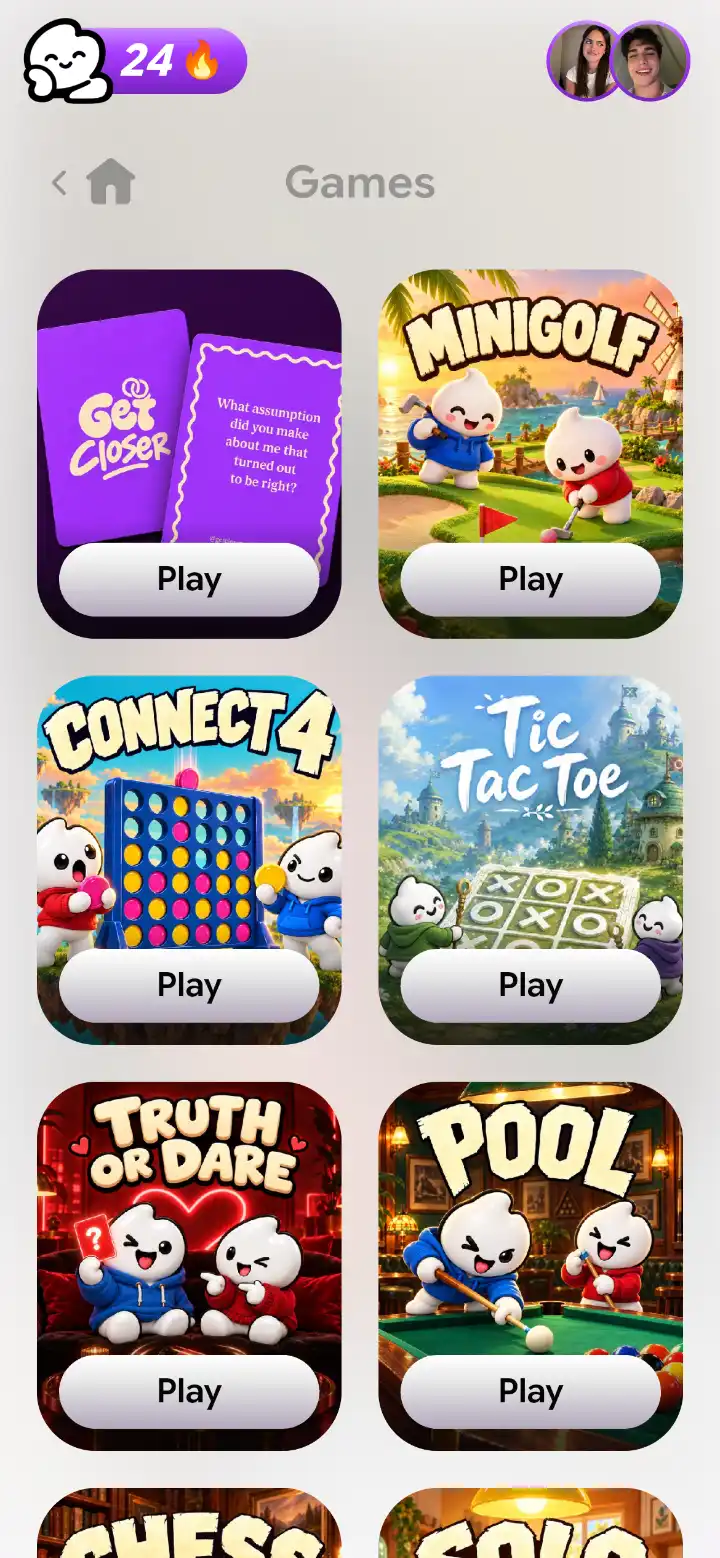
Cupie is a free video call app for couples. You call inside the app, pick a game and it plays live on both phones while you see each other. Five games are open from day one (Get Closer, Minigolf, Four in a Row, Tic Tac Toe and Truth or Dare), and nine more open as your daily call streak grows. There is also a private couple chat and a new couple quiz every morning.
Honest limits: both of you need the app, and it is phone only (iPhone and Android, no web or desktop version). It is newer and smaller than Paired or Between.
Daily questions: Paired, Agapé, Lovewick
These apps send a question you both answer, and you see each other's answer once you've both replied. They are great when one of you is asleep. The common complaints in App Store reviews are price and repetition: Agapé reviewers mention "repeat but reworded questions", Paired reviewers mention the trial and pricing, and Lovewick reviewers were unhappy when the free allowance dropped to one question a day. Our Paired alternatives guide compares them.
Widgets: Locket, Widgetable, Couple Joy
Widgets help with the "lonely in between" feeling: you see your partner every time you pick up your phone. Reviewers of Widgetable complain about ads and slow free progress, and Couple Joy reviewers say the free tier is thin. More in our couple widget apps guide.
Which long distance apps have the best reviews from couples?
On the US App Store in October 2026: Widgetable (4.9, about 388,000 ratings), Couple Joy (4.9, about 40,000), Between (4.8, about 21,000), Agapé (4.8, about 26,000), Locket (4.8, about 586,000), Candle (4.8, about 12,000), Lovewick (4.8, about 1,900) and Paired (4.7, about 210,000). Cupie has 4.8 stars on both the App Store and Google Play.
Almost every popular app sits between 4.7 and 4.9, so stars won't pick for you. Read the 1 to 3 star reviews instead; they tell you what the app is bad at. Here is what long distance couples say about Cupie:
"me and my partner are long distance with me being in the military and we downloaded this yesterday and it was brilliant." (App Store review, UK)
"I absolutely love this app. The quizzes are great to get to learn your partner more and there's so much built it. I think it's perfect for long distance couples looking to build that connection." (MarieJordan00, App Store)
For a full feature and price comparison, see Cupie vs Between vs Paired vs Widgetable and our list of the best long distance relationship apps. For things to do on your next call, try our long distance relationship games.
FAQ
Do long distance relationship apps actually work?
They help with specific problems, not with the relationship as a whole. Apps that give you something to do together on a call, like games or question decks, tend to make calls longer and less repetitive. Async apps like daily questions or photo widgets help in the hours you can't talk. No app fixes a missing plan to close the distance.
Which couples apps make long distance feel less lonely?
Two kinds help most. Presence apps put your partner on your home screen all day, like Locket, Widgetable or Cupie's partner widget. Live apps give you shared moments, like Cupie, a free video call app for couples on iPhone and Android where you play games together inside the call, or Teleparty for watching shows in sync.
Will my long distance relationship work?
It can. A Cornell study found long distance couples reported more intimacy than nearby couples because they shared more and tried harder, and a national study of 870 people found long distance partners rated their relationship as high or higher on several measures. What predicts trouble is less the distance and more the lack of an end date, routine and honest talk.
What kills long distance relationships?
The common killers are no end date, calls that turn into the same 'how was your day' every night, effort that is unbalanced, jealousy that goes unspoken, and a big gap between the idealized partner on screen and the real person during visits. Most of these can be spotted early and talked about.
Which long distance apps have the best reviews from couples?
On the US App Store in October 2026, Widgetable and Couple Joy had 4.9 stars, and Between, Agapé, Locket and Candle had 4.8. Star ratings say little about fit, so read the critical reviews: common complaints are paywalls, repeated questions and ads.
How many long distance couples use apps to stay in touch?
We can only speak for Cupie: in our July to October 2026 data, 32.1% of couples had partners in different time zones, and up to 23.7% had partners in different countries.
How we made this page: researched and drafted with help from AI tools, then reviewed and edited by Niclas Illg against the sources below and the official app listings on October 30, 2026. Cupie is our own app, and we say so wherever we compare it.
Sources
- Cupie data report 2026: how couples play on video calls
- Cornell Chronicle: New media allows requited love to know no distance (Jiang and Hancock, 2013)
- Stanford Social Media Lab: Absence makes the communication grow fonder
- Psychology Today: The advantages of long-distance relationships (summary of Kelmer et al., 2013)
- Cupie on the App Store
- Cupie on Google Play
- Paired on the App Store
- Agapé on the App Store
- Between on the App Store
- Widgetable on the App Store
- Couple Joy on the App Store
- Candle on the App Store
- Locket Widget on the App Store
- Lovewick on the App Store